
Accessing accurate property information is essential for homeowners, real estate professionals, developers and surveyors in Tuscarawas County. GIS maps and property boundary tools allow users to visualize land parcels, understand dimensions, and make informed decisions for buying, selling or developing land. This comprehensive guide will help you navigate Tuscarawas County GIS resources, property boundaries, and related lookup tools.
What is GIS Mapping in Tuscarawas County?
GIS (Geographic Information System) mapping is a technology that stores, analyzes and displays geographic data. In Tuscarawas County, GIS maps provide precise spatial information about land parcels, infrastructure, topography, zoning, and environmental features.
Benefits of GIS mapping include:
- Accurate property boundaries visualization
- Land planning and development assistance
- Environmental and topographic insights
- Integration with zoning and tax data
How GIS Maps Work
GIS maps are built with multiple layers, each representing a different type of data:
- Parcel Boundaries: Exact outlines of individual properties
- Topography & Natural Features: Rivers, elevation, forests, and wetlands
- Infrastructure: Roads, utilities, public facilities
- Zoning & Land Use: Residential, commercial, industrial, and agricultural areas
- Environmental Data: Flood zones, soil types, conservation areas
- Users can toggle these layers to see detailed information, measure property dimensions and analyze relationships between parcels and surrounding features.
Property Boundaries Lookup in Tuscarawas County
A property boundaries lookup provides the official layout of a parcel, showing its perimeter, dimensions, and sometimes ownership information. Tuscarawas County offers online GIS and parcel tools for easy access.
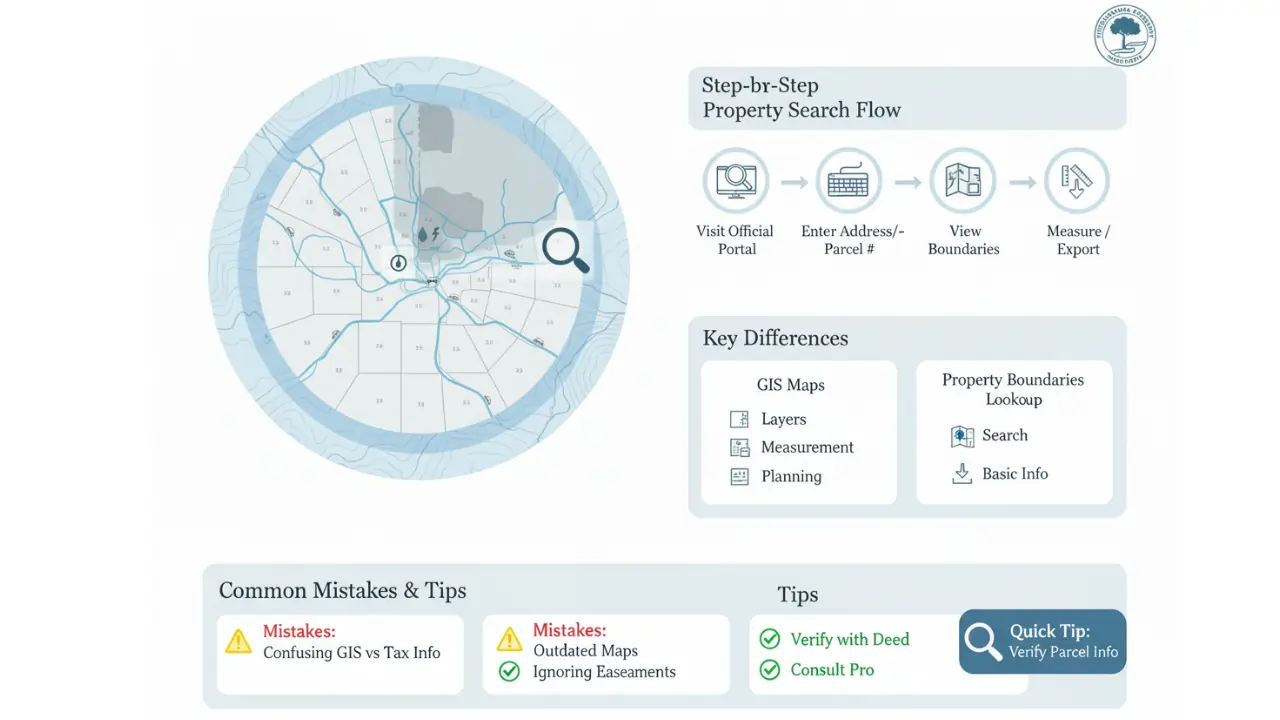
Step-by-Step Guide to Lookup Property Boundaries
- Visit the Tuscarawas County GIS Portal
- Official portal: Tuscarawas County GIS
- Ensure you are using the most updated county site to avoid outdated maps.
- Search by Address or Parcel Number
- Enter the street address, subdivision, or parcel ID.
- Parcel numbers are typically listed on the Auditor’s property records.
- Access the Parcel Map View
- The map will display the selected parcel highlighted.
- Adjacent properties are also visible for reference.
- Explore Map Layers
- Toggle layers for zoning, floodplain, utility lines, or topography.
- Use measurement tools to confirm property size or boundary lengths.
- Print or Export Maps
- Optional: Download PDF or image versions for personal use or legal reference.
- Cross-Reference with Official Deeds
- For legal matters, verify online maps with recorded deeds to ensure accuracy.
GIS Maps vs Property Boundaries Lookup
| Feature | GIS Maps | Property Boundaries Lookup |
|---|---|---|
| Purpose | Comprehensive spatial data | Exact property perimeter |
| Data Included | Zoning, topography, utilities, parcels | Parcel dimensions, ownership, location |
| Interaction | Layer toggling, analysis, measuring tools | Search by address or parcel ID |
| Best For | Planning, research, environmental analysis | Real estate, surveying, development |
| Frequency of Update | Regular, may vary by dataset | Often synced with Auditor’s official records |
Common GIS Tools and Their Functions
| Tool | Purpose | Tip |
|---|---|---|
| Measurement Tool | Measure parcel length/area | Always cross-check with deed |
| Layer Selector | Toggle zoning, flood zones, utilities | Helps visualize overlapping features |
| Search Function | Find parcels by address or ID | Use full street names for accuracy |
| Print/Export | Create PDF or image of map | Ensure latest map version is selected |
Common Mistakes When Using GIS Maps and Property Lookups
- Confusing GIS maps with tax or valuation info
- GIS maps primarily show spatial and boundary data, not tax assessments.
- Relying on outdated maps
- Third-party websites may have old GIS layers; always use the official county portal.
- Ignoring adjacent parcel information
- Boundaries are relative; neighboring lots can affect development plans.
- Assuming online maps are legally binding
- Only official surveys and recorded deeds are legally accurate.
- Misinterpreting easements or right-of-way lines
- Some maps show easements as thin lines; ignoring them can cause disputes.
- Overlooking environmental layers
- Floodplains, wetlands, or conservation zones affect property use.
Tips for Accurate Property Research
- Verify parcel numbers with the Tuscarawas County Auditor
- Cross-reference GIS maps with official recorded deeds
- Use measurement tools for precise boundary confirmation
- Check for updated GIS releases regularly
- Understand zoning codes for permitted land use
Real-Life Use Cases
- Homebuyers: Confirm property lines before purchase to avoid disputes.
- Developers & Builders: Plan construction with accurate land dimensions and zoning compliance.
- Surveyors: Cross-check GIS maps with field measurements for legal documentation.
- Environmental Consultants: Evaluate parcels in floodplains or conservation areas.
Additional Resources
- Tuscarawas County Auditor’s Office: Property ownership, tax data, and official parcel numbers.
- County GIS Department: Updated maps, technical support, and training guides.
- Ohio GIS Clearinghouse: Statewide geographic datasets for advanced research.
Conclusion
Tuscarawas County GIS maps and property boundaries lookup tools are essential for accurate property research, land development, and real estate planning. By following official portals, using step-by-step guides, and avoiding common mistakes, residents and professionals can ensure reliable and up-to-date property information. Always verify with official surveys for legal decisions, and use GIS layers to enhance planning and understanding of your property.