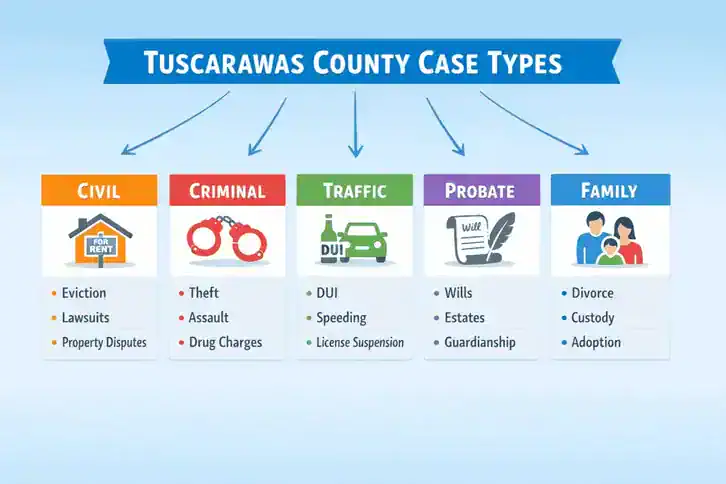
When someone searches for a court case in Tuscarawas County, they are usually not doing it out of curiosity. They are anxious. Maybe their name showed up in a database. Maybe a loved one is involved. Maybe they received a notice in the mail with words that feel cold and threatening. The first thing they see is a “case type” and suddenly everything feels heavier. Civil. Criminal. Traffic. Probate. Family. These labels look simple, but they decide how serious the matter is which court handles it, and how it may affect a person’s future.
This guide exists for one reason: to replace panic with clarity. By the time you finish reading, you will understand exactly what each case type in Tuscarawas County means, how serious it usually is, which court handles it, whether it becomes public record, and what you should do after you find a case.
Understanding How Courts Work in Tuscarawas County
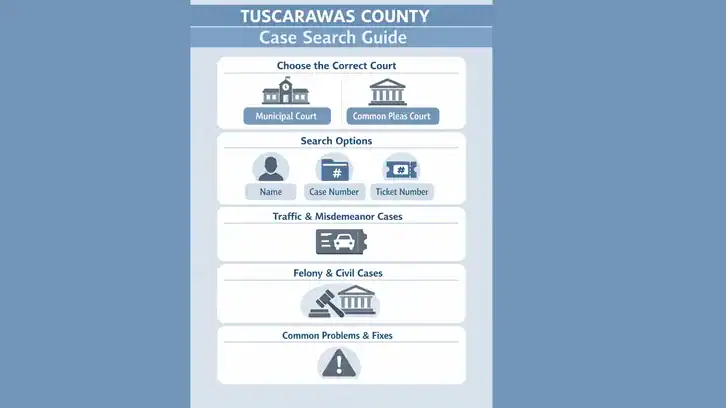
Tuscarawas County uses two main court systems. The Tuscarawas Municipal Court handles most traffic matters, minor criminal offenses, and small civil disputes. The Tuscarawas County Court of Common Pleas handles serious criminal charges, larger civil lawsuits, domestic relations, and probate matters.
When you search for a case and see where it is filed, that alone tells you a lot. A case in Municipal Court often involves lower-level issues like speeding tickets, misdemeanors, or small claims. A case in the Court of Common Pleas usually means something more serious or more complex.
Knowing the court helps you interpret the risk and urgency of the situation.
| Court Name | Handles These Case Types | Examples of Issues |
|---|---|---|
| Tuscarawas Municipal Court | Traffic, Misdemeanors, Small Civil Disputes | Speeding tickets, DUI, small claims |
| Court of Common Pleas – Criminal | Felony Criminal Cases | Burglary, serious drug charges |
| Court of Common Pleas – Civil | Large Civil Lawsuits | Property disputes, major money claims |
| Court of Common Pleas – Family | Divorce, Custody, Support | Divorce filings, child custody |
| Court of Common Pleas – Probate | Estates, Guardianships, Adoptions | Inheritance, wills, guardianship cases |
Civil Cases in Tuscarawas County
A civil case is a dispute between people, businesses, or organizations. No one is being accused of a crime. Instead, someone believes they were wronged and is asking the court for money, property, or a legal decision.
In Tuscarawas County, civil cases often include landlord-tenant disputes, debt collection, small claims, personal injury claims, contract disagreements, and property conflicts. These cases may be filed in Municipal Court or in the Court of Common Pleas depending on the dollar amount and complexity.
If you see “civil” next to a case, it does not mean jail. It means someone is seeking a legal remedy. However, civil cases can still carry real consequences. A judgment can affect your credit, your ability to rent, or even your ownership of property.
Civil case meaning becomes clearer when you imagine real-life scenarios. An eviction filed by a landlord. A hospital suing for unpaid bills. A neighbor disputing a boundary line. These are not crimes, but they still shape lives.
Criminal Cases: Misdemeanor vs Felony
Criminal cases involve the state accusing someone of breaking the law. In Tuscarawas County, minor criminal cases are usually handled in Municipal Court, while serious charges go to the Court of Common Pleas.
Criminal vs civil is the most important distinction you can make. Civil cases are about disputes. Criminal cases are about alleged offenses against the law.
Misdemeanors include offenses like petty theft, disorderly conduct, simple assault, and some drug charges. Felonies involve more serious allegations such as burglary, robbery, major drug offenses, and violent crimes.
The difference between felony vs misdemeanor in Ohio is not just legal language. It affects potential jail time, fines, future employment, housing, and background checks. A misdemeanor may still appear on a record. A felony can follow a person for decades.
When you see a criminal case, it is serious by nature. The level of seriousness depends on whether it is a misdemeanor or felony, but every criminal case deserves attention.
Traffic Cases Are Not Always Minor
Many people assume traffic cases are harmless. Some are. A basic speeding ticket or expired registration is often resolved with a fine. But in Tuscarawas County, traffic cases can become serious very quickly.
Driving under the influence, reckless operation, driving under suspension, and hit-and-run incidents are traffic matters that carry criminal penalties. DUI in Ohio can lead to jail, license suspension, and long-term record consequences.
A traffic case in Municipal Court might look small at first glance, but it can affect insurance rates, driving privileges, and even employment. Some traffic violations escalate into criminal matters, especially if they involve alcohol, injury, or repeat offenses.
Understanding this prevents the mistake of ignoring a traffic case because it “sounds small.”
Probate and Family Court Cases
Probate and family cases confuse many people because they are emotional and unfamiliar.
Probate court in Tuscarawas County handles estates after someone passes away, guardianships, adoptions, and mental health commitments. A probate case does not mean wrongdoing. It means the court is supervising a legal process involving life, death, and responsibility.
Family court cases include divorce, child custody, child support, spousal support, and domestic relations. These cases shape families, finances, and futures. Even though they are civil in nature, their impact is deeply personal.
Divorce records, custody disputes, and guardianship filings often become public records unless sealed. Many people are shocked to learn how visible these matters can be.
Understanding probate court Ohio and family court cases helps remove fear. These are not criminal courts. They exist to manage transitions in life that are already hard.
Which Court Handles What in Tuscarawas County
This single piece of knowledge saves hours of confusion. People often search in the wrong system and think a case does not exist.
Tuscarawas Municipal Court typically handles traffic violations, misdemeanors, and small civil cases. The Tuscarawas County Court of Common Pleas handles felonies, large civil lawsuits, domestic relations, and probate matters.
If you are searching for a DUI, speeding ticket, or misdemeanor assault, Municipal Court is the place. If you are searching for a felony, divorce, estate, or major lawsuit, you need the Court of Common Pleas.
This distinction explains why many searches “fail.” The case is real. It is just in the other system.
Are These Cases Public Records?
Most court cases in Ohio are public records. That includes civil, criminal, traffic, probate, and family matters. Anyone can search them.
There are exceptions. Some cases are sealed. Some records are expunged. Juvenile cases are often restricted. Certain sensitive family matters may be protected.Sealed cases exist but are not visible to the public. Expunged records are removed entirely. However, most people you search for will still appear if they have open or past cases.
This matters because court records affect background checks in Ohio. Employers, landlords, and lenders often review them. Even a resolved case can leave a digital footprint.Knowing what is public and what is not helps people manage expectations and plan their next steps.
How Case Types Affect Real Life
A case type is not just a label. It determines how others see the situation.
A civil judgment may affect credit and housing. A criminal case can affect employment and reputation. A traffic conviction can raise insurance and suspend licenses. A probate filing may delay inheritance. A family court order may define years of parenting.People often search because they are scared of what comes next. Understanding the category allows you to predict impact.
A minor offense may result in a fine. A felony charge may require legal counsel immediately. A probate case may require patience and documentation. A family case may require emotional preparation and long-term planning.
| Case Type | Typical Impact on Life | Long-Term Risk Level |
|---|---|---|
| Civil | Credit damage, property loss, financial stress | Medium |
| Criminal | Jail risk, job barriers, permanent record | High |
| Traffic | Fines, license suspension, insurance increase | Low to High |
| Family | Custody outcomes, financial obligations, privacy loss | Medium to High |
| Probate | Delayed inheritance, legal responsibility | Low to Medium |
Real Examples That Help You Identify Your Case
Common Issues and Their Case Types
- DUI: Traffic or criminal case in Municipal Court
- Eviction: Civil case, usually Municipal Court
- Unpaid debt: Civil case or small claims
- Theft: Criminal case, misdemeanor or felony
- Divorce: Family case in Court of Common Pleas
- Inheritance dispute: Probate case
- Speeding ticket: Traffic case
- Assault: Criminal case
- Child custody: Family court case
- Estate administration: Probate case
Seeing your situation in plain words removes the guesswork.
What To Do After You Find a Case
People rarely stop at “I found it.” They immediately think, “Now what?”
The right response depends on the type.
Practical Next Steps by Case Category
- Civil: Read the filing. Check deadlines. Consider legal advice if money or property is at risk.
- Criminal: Take it seriously. Note court dates. Seek legal counsel.
- Traffic: Do not ignore it. Pay, contest, or appear as required.
- Probate: Understand your role. Executor, heir, or interested party each has different rights.
- Family: Prepare emotionally and practically. These cases are long-term.
“How to search court case” is only half the journey. The other half is knowing how to respond once you see the result.
Why Legal Language Feels So Hostile
Court terminology is built for professionals, not for people in stress. Words like “plaintiff,” “defendant,” “arraignment,” and “motion” create distance.
This guide exists to translate. A plaintiff is the person who filed. A defendant is the person responding. An arraignment is the first criminal court appearance. A motion is a formal request.
Building Confidence Through Understanding
People do not panic because they see a case. They panic because they do not understand it.
Once you know that civil is about disputes, criminal is about alleged offenses, traffic can be minor or serious, probate manages life transitions, and family court shapes relationships, the fog clears.
Case types stop being threats and start being signals. Signals you can interpret. Signals you can respond to.
That is the real purpose of this guide.
Final Thoughts: From Fear to Control
Most people arrive at court records in a moment of stress. A letter in the mail. A name in a database. A rumor that becomes a search. The system feels cold because it speaks in codes instead of compassion.
Understanding case types in Tuscarawas County changes that experience. Civil stops meaning danger. Criminal stops meaning mystery. Traffic stops being dismissed. Probate and family stop feeling alien.You do not need to become a lawyer. You only need enough clarity to know what you are facing. Once you have that, panic turns into planning. Confusion turns into direction.
A case type is not a verdict on your future. It is simply the category of a problem. Problems can be solved. And the first step is understanding what kind of problem it is.
FAQs
What is the most serious case type in Tuscarawas County?
Felony criminal cases in the Court of Common Pleas are the most serious. They can lead to long-term imprisonment and permanent record consequences.
Are all traffic cases minor?
No. Some traffic violations, like DUI or driving under suspension, carry criminal penalties and long-term impact.
Can civil cases put me in jail?
No. Civil cases do not involve jail. They can result in financial judgments, property loss, or court orders.
Are divorce records public in Ohio?
Most divorce filings and outcomes are public unless sealed by the court for specific reasons.
How do I know which court to search?
Minor offenses, traffic, and small disputes are in Municipal Court. Felonies, probate, and family matters are in the Court of Common Pleas.